
Live data
Gold Price API
Real-time gold spot prices in 180+ currencies.
If you are running a fintech app, managing a jewelry e-commerce storefront, or overseeing a precious metals trading desk, last week’s gold market action likely kept your engineering and finance teams on high alert.
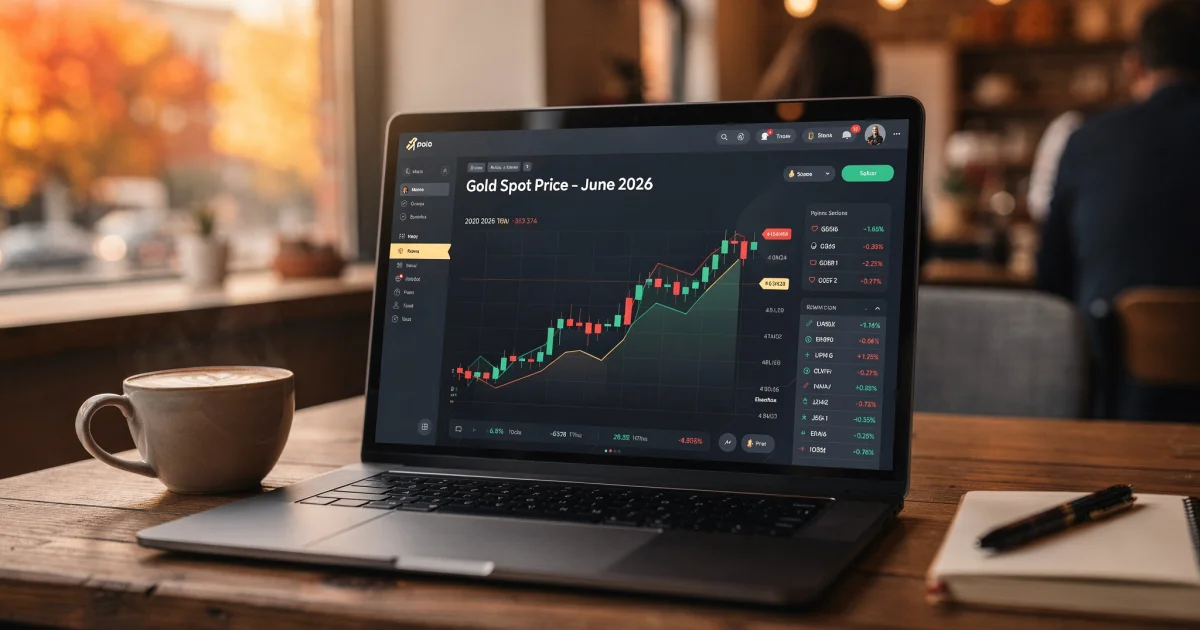
For the third consecutive week, bullion extended its downward correction. Spot gold prices shed roughly 1.49% (down about $62.95), closing the week ending June 19, 2026, at $4,156.68 per ounce. While gold is still up over 23% compared to this time last year, the speculative steam that drove the asset to historic highs earlier in 2026 is rapidly cooling off.
When macro shifts trigger abrupt technical corrections, your systems cannot afford to rely on cached or delayed pricing. Platforms leveraging high-frequency data feeds can stay ahead of the curve by integrating a high-performance gold price API to capture structural pivots in real time.
The Core Drivers Behind the June Correction
Two major macroeconomic forces converged last week to push gold below its short-term moving averages. If your software relies on automated buy/sell spreads, understanding these triggers helps explain the sudden uptick in trade volumes.
1. The Federal Reserve's "Higher-for-Longer" Hammer
The primary catalyst remains the U.S. Federal Reserve’s stubbornly hawkish posturing. Despite some market hopes for an easing cycle, monetary policymakers kept the benchmark Fed Funds rate steady at 3.75%.
Even more damaging to non-yielding assets like gold was the central bank's communication: several officials openly discussed the potential necessity of an additional rate hike before the year concludes. This sent the U.S. Dollar Index (DXY) climbing to its strongest level in over a year, while driving Treasury yields north. When interest-bearing assets offer safer, higher returns, capital naturally rotates away from physical bullion.s
2. Goldman Sachs Trims Year-End Forecasts
Institutional sentiment took a visible hit on Friday, June 19, when Goldman Sachs lowered its year-end gold price target to $4,900 per ounce (down from its previous forecast of $5,300).
While Goldman’s updated target still implies a healthy medium-term upside from today’s $4,156 mark, the sudden adjustment prompted a 1.5% single-day liquidation from institutional desks. J.P. Morgan similarly trimmed its full-year average expectations earlier to $5,243, confirming a broader wall of institutional caution.
3. Geopolitical Risk Premiums Recede
Part of gold's massive premium earlier this year was built on geopolitical volatility in the Middle East. However, recent diplomatic updates—including progress toward a comprehensive U.S.–Iran framework—have temporarily defused structural supply-chain anxieties. With shipping expectations through critical corridors normalizing, the safe-haven premium embedded in commodity prices has noticeably leaked out.
Last Week by the Numbers
To help map out your systemic data parameters, here is how the broader precious metals complex and relevant macro indicators closed the week:
Metric / Asset | Closing Value (Week Ending June 19, 2026) | Weekly Performance / Context |
|---|---|---|
Spot Gold (XAU) | $4,156.68 / oz | ▽ 1.49% (Third consecutive weekly loss) |
Spot Silver (XAG) | $64.91 / oz | ▽ 2.12% (Leading the broader metals slide) |
U.S. Fed Funds Rate | 3.75% | Unchanged; forward guidance remains hawkish |
Goldman Sachs Target | $4,900 / oz | Slashed from previous $5,300 baseline |
1-Month Price Momentum | Down 8.52% | Technical trend points to short-term consolidation |
The Developer Takeaway: Building for Volatility
A sideways or downward-trending market doesn’t mean lower trading activity—in fact, it often means the opposite. Retail profit-taking, margin calls, and institutional rebalancing generate immense transactional volume.
If your application handles automated conversions or portfolio valuations, stale data can lead to massive arbitrage vulnerabilities or bad execution fills. For instance, during the Friday session where gold dipped over 1.3% in a matter of hours, a latency delay of even a few minutes could result in systemic losses on customer liquidations.
By connecting directly to Metal Sentinel's developer-first gold price API, your platform gains access to institutional-grade, low-latency spot tracking. Secure your margins with customizable websocket streams, ultra-reliable REST endpoints, and comprehensive historical data packages built to withstand sudden market corrections.
Ready to protect your platform from pricing latency? Explore our API documentation.